If you have ever stressed out about the Methods section of a research paper, you are certainly not alone. For many classroom teachers, even experienced educators, providing a methodological account of classroom research in a form that journal reviewers expect can be a daunting task. Research on novice academic writers suggests that this process often creates a significant cognitive burden, leaving writers feeling overwhelmed and anxious (Shah et al., 2009).
Much of the stress stems from the high-stakes nature of the Methods section itself. Reviewers routinely use this section to judge a study’s overall validity, making it central to decisions about whether a manuscript can be trusted (Kallet, 2004). As a result, your professional reputation can feel as though it is on the line (Lövei, 2021), since the clarity and carefulness of the Methods section are commonly taken as evidence of transparency, rigor, and credibility (Criss, 2021). For classroom teachers who know their teaching context inside and out, this can be an especially difficult position to navigate. Even when you have valuable insights to share, it is often unclear which aspects of classroom inquiry must be reported to meet peer-review expectations (Burns, 2019). This is a tough reality of academic publishing: If the Methods section does not work, the rest of the paper may never get the attention it deserves (Willis, 2023).
Although a comprehensive treatment of the Methods section is beyond the scope of this column, the aim here is to point you in a productive direction. To do so, I will draw on my experience as a reviewer and organize the discussion around a small set of key questions that reviewers typically consider when evaluating a manuscript. By making these implicit expectations more explicit, I hope to reduce some of the uncertainty and anxiety surrounding this section and help the task of writing a strong Methods section feel more manageable. The column concludes with a practical action plan designed to respond to common reviewer concerns. Think of this piece as a “quick-start guide” that provides an essential orientation to begin writing with greater confidence, clarity, and a sense of direction. Let us begin with one of the most fundamental purposes of the Methods section: establishing trust.
Can I Trust This Study?
Writing a strong Methods section that builds trust in your study’s overall quality begins with a clear understanding of its role within the manuscript as a whole. This section is not simply a list of everything you did, rather it functions as a justification for your entire study (James Madison University Writing Center, n.d.). It should provide enough detail for readers to understand how the research was conducted and, in principle, to replicate it (PLOS, n.d.). Crucially, this involves explaining why particular procedures were chosen and demonstrating that the approach taken was appropriate for answering the research questions posed (Kallet, 2004). This attention to transparency is a key driver of trust. For classroom teachers, this expectation carries a specific implication: Being intimately familiar with your own teaching context is an advantage, but that familiarity cannot be assumed by readers. Just because you are clear about your context does not mean your audience will be. Your Methods section therefore needs to do more than report hunches, impressions, or random details. Instead, it should offer a clear and grounded account of the research setting, making explicit the cultural, social, and educational factors that shape the inquiry and give it meaning (Burns, 2009). Such contextual richness builds trust because it helps reviewers understand not only what you did, but why those choices made sense in your particular setting.
One practical way to judge how much detail to include is to imagine writing for your future self ten years from now: What information would you need in order to understand and replicate the study, at least in principle (PLOS, n.d.)? If you can answer this question to your satisfaction, you are doing much of the work needed to make your reasoning transparent and easy for reviewers to follow. Trust naturally follows.
Finally, another essential element of building trust in your work is demonstrating adherence to ethical standards. This is critical because reviewers are looking for clear evidence that you have obtained proper, informed consent from participants and have adhered to institutional guidelines (Burns, 2009, Mahboob et al., 2016). In other words, you cannot just give your students a survey, do a few follow-up interviews, and call it a day. Although obtaining informed consent does require additional time and preparation, the process of securing permissions from both your students and institution can be productive. Drafting consent materials, in particular, often helps researchers clarify their data collection and analysis procedures early in the research process, strengthening the overall design of the study (Gough & Handley, 2020). From personal experience, I can attest that even lengthy and iterative ethics review processes ultimately provide a valuable sense of assurance for both researchers and reviewers that a study has been carefully planned and responsibly conducted.
Do the Methods Align With the Research Aims?
In addition to overall trustworthiness, reviewers also typically look at the degree of alignment between your chosen methods and research aims. Data collection, after all, is an eclectic process, and its choice depends completely on the questions posed (Mahboob et al., 2016). The question of fit, not methodological sophistication or prestige, is prioritized when evaluating a paper. In fact, doubting the appropriacy of your methods is often grounds for rejection regardless of findings (Lövei, 2021).
To improve methodological alignment, it is important to understand that different research questions require different kinds of evidence. One common mistake is choosing a particular method because it seems more “scientific”. Although quantitative methods can be entirely appropriate, they may be poorly suited to studies in which the research questions are primarily qualitative in nature. Table 1, adapted from Criss (2021) and Mahboob et al. (2016), illustrates the types of research questions and evidence suitable for the three main methodological traditions (qualitative, quantitative, and mixed-methods).
Table 1
Aligning Methodological Approaches With Research Aims
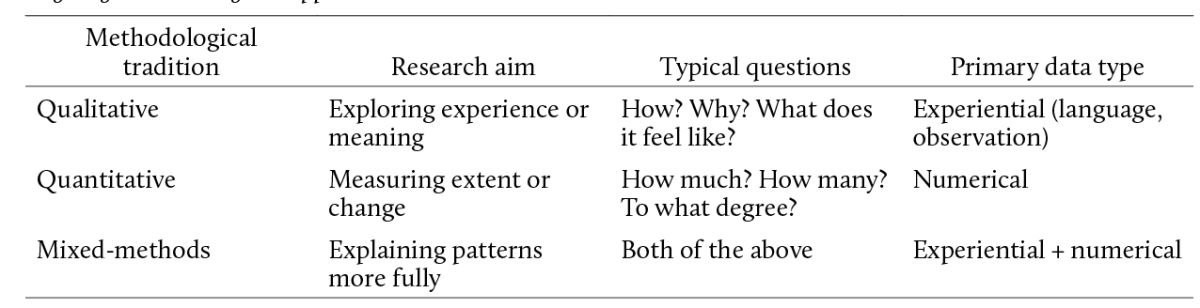
Note. Adapted from Criss (2021) and Mahboob et al. (2016)
A key point to remember is that no methodological approach is inherently better than any other. For teachers interested in investigating their classroom experience, the most appropriate choice ultimately depends on a strategic decision grounded in the specific puzzle or dilemma being explored (Burns, 2010). Adopting a systematic and principled approach that clearly explains why particular tools were chosen to address the research questions signals sound research judgment and strengthens a study in the eyes of reviewers (Criss, 2021; Mahboob et al., 2016).
Are the Methods Logically Organized?
Suppose you have done your best to signal trustworthiness and align your methods with your research aims; a Methods section that is disorganized or difficult to follow can undermine your effort. Speaking again from experience, reviewers rely heavily on organization to efficiently evaluate methodological rigor. Methods sections that follow a clear and primarily chronological structure are easier to read and tend to create a more favorable impression, particularly when reviewers are assessing the coherence of a study under time constraints (Willis, 2023).
Viewing the Methods section as a genre in its own right—with recognizable organizational patterns—can provide a reassuring sense of direction that can help you meet both reviewer and reader expectations. Research suggests that the number of rhetorical moves commonly found in Methods sections is relatively small and straightforward. In a genre analysis of Methods sections in education research articles, Zhang and Wannaruk (2016) found that a limited set of rhetorical moves tends to recur across studies (Table 2).
Table 2
Common Rhetorical Moves in Methods Sections
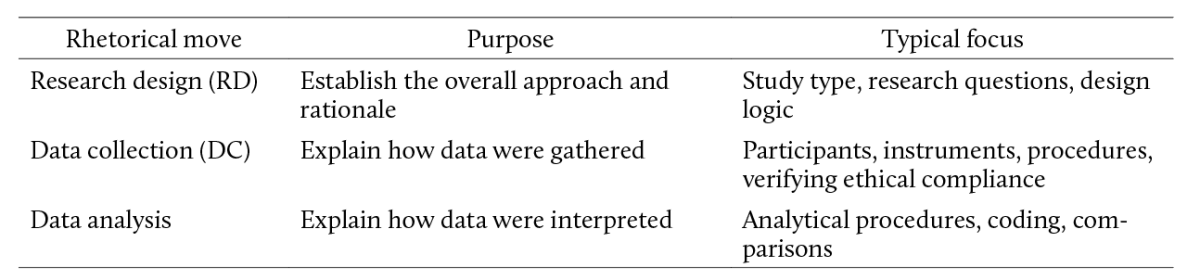
These rhetorical moves provide a clear and straightforward map of the functional components that need to be included in a Methods section. For those of you whose first language is not English, this genre-based map can be particularly reassuring, as it clarifies what needs to be accomplished at each stage of the Methods section. When the research design, data collection, and data analysis steps are made visible, reviewers can more easily assess the coherence and rigor of your study. However, there is some flexibility within these conventions. Depending on the nature of a particular study, the order in which these moves are presented and the labels used to describe them may vary in response to differences in research design or journal expectations (James Madison University Writing Center, n.d.). What matters most is not adherence to a rigid sequence, but a clear signaling of what each part of the Methods section is doing for the reader (Zhang & Wannaruk, 2016). If you are constructing a Methods section for the first time, a practical approach is to follow a largely chronological order, describing your study as it unfolded and clearly signposting any departures from that sequence (Willis, 2023).
Is the Writing Clear and Complete?
In order to improve the trustworthiness, alignment, and organization of your next Methods section, here is a simple six-step action plan you can follow to address typical reviewer concerns.
Step 1: Write the Study Backwards
A great way to organize and plan your study’s methodology is to tackle this aspect first before data collection begins, ideally while simultaneously obtaining informed consent and ethics approval (Grough & Handley, 2020). Waiting until later puts you at risk of forgetting key details (Lövei, 2021).
Step 2: Distinguish Procedure From Rationale
One common pitfall novice academic writers fall into is trying to do too much at once by collapsing description and justification, which can make a Methods section difficult to follow cognitively (Shah et al., 2009). For greater clarity, begin by explaining what you did and then explain why you made those choices. Keeping these two functions distinct makes the logic of your study easier for reviewers to follow.
Step 3: Justify Decisions, Not Outcomes
In the Methods section, it is important to avoid mentioning results or interpretations. At this stage, reviewers are looking for a clear rationale for your methodological decisions, not evidence of the study’s success (Criss, 2021). Discussion of outcomes should be reserved for later sections of the paper.
Step 4: Treat Classroom Constraints As Data, Not Flaws
In most forms of practitioner research, contextual limitations are to be expected and should be reported transparently rather than concealed. Approach your study’s “flaws” critically rather than defensively, as reflecting on constraints strengthens your argument by helping reviewers understand how context shaped the study and its findings (Burns, 2009).
Step 5: Use Exemplars From Your Target Journal
When constructing your Methods section, draw inspiration from published studies with similar research designs in the journal you are targeting. Reading and analyzing such exemplary articles can help you internalize expectations for organization, level of detail, and methodological framing (James Madison University Writing Center, n.d.; Mahboob et al., 2016).
Step 6: Check That Nothing Important Is Missing
Once you have completed an initial draft, consult an established set of research reporting guidelines to ensure that all necessary elements have been included. Many ELT-related journals—including those published by JALT—follow the APA Journal Article Reporting Standards (JARS), which provide a concise checklist of what should be reported for qualitative, quantitative, and mixed-methods studies (American Psychological Association, 2025). Rather than writing directly from these standards, it may be more productive to use them as a final mirror to identify anything that may be missing or unclear. Used strategically, JARS makes reviewer expectations explicit and allows you to address them proactively rather than discovering omissions through reviewer comments (Talandis, 2023).
Final Thoughts
In this short column, I have aimed to provide an overview of the Methods section of a research paper in a way that makes it more approachable and manageable. It is worth remembering that the Methods section is not about displaying expertise or scientific perfection. Rather, it is about demonstrating care, transparency, and careful thinking in a way that is principled and defensible. Ultimately, it reflects how thoughtfully a study was designed, not how impressive it appears on the surface. As a qualified and experienced educator, you already possess the qualities needed to write an effective Methods section. By approaching your Methods as a form of professional storytelling and explaining what you planned, what you did, and how you made sense of it (Burns, 2009), you draw on skills you use daily in your teaching practice. Articulating aims, plans, and decisions clearly and transparently is something you already do with your students. With that in mind, you can approach academic writing with confidence, knowing that you already have what it takes.
References
American Psychological Association. (2025, December). Journal article reporting standards (JARS). APA Style. https://apastyle.apa.org/jars
Burns, A. (2009). Doing action research in English language teaching: A guide for practitioners. Routledge.
Criss, M. J. (2021). Methodology section for research papers. San José State University Writing Center. https://www.sjsu.edu/writingcenter/docs/handouts/Methodology.pdf
Gough, W., & Handley, C. (2020). How to write participant consent forms. The Language Teacher, 44(2), 39–42. https://doi.org/10.37546/JALTTLT44.2
James Madison University Writing Center. (n.d.). Method sections for empirical research papers. https://www.jmu.edu/learning/writing-center/_files/link-library/empirica...
Kallet, R. H. (2004). How to write the methods section of a research paper. Respiratory Care, 49(10), 1229–1232. https://pubmed.ncbi.nlm.nih.gov/15447808/
Lövei, G. L. (2021). Writing and publishing scientific papers: A primer for the non-English speaker. Open Book Publishers. https://doi.org/10.11647/OBP.0235
Mahboob, A., Paltridge, B., Phakiti, A., Wagner, E., Starfield, S., Burns, A., Jones, R. H., & De Costa, P. I. (2016). TESOL Quarterly research guidelines. TESOL Quarterly, 50(1), 42–65. https://doi.org/10.1002/tesq.288
PLOS. (n.d.). How to write your methods. https://plos.org/resource/how-to-write-your-methods/
Shah, J., Shah, A., & Pietrobon, R. (2009). Scientific writing of novice researchers: What difficulties and encouragements do they encounter? Academic Medicine, 84(4), 511–516. https://doi.org/10.1097/ACM.0b013e31819a8c3c
Talandis Jr., J. (2023). Exploring APA: Journal article reporting standards. The Language Teacher, 47(2), 51–53. https://doi.org/10.37546/JALTTLT47.2
Willis, L. D. (2023). How to write the methods section of a research manuscript. Respiratory Care, 68(12), 1763–1770. https://doi.org/10.4187/respcare.11437
Zhang, B., & Wannaruk, A. (2016). Rhetorical structure of education research article methods sections. PASAA: Journal of Language Teaching and Learning in Thailand, 51, 155–184. https://doi.org/10.58837/CHULA.PASAA.51.1.6