
Paul Nation is an emeritus professor at Victoria University of Wellington, specializing in the teaching and learning of vocabulary and language teaching methodology. Laurence Anthony is a professor at Waseda University, specializing in language data science and educational technology. The two have continued a long-term collaboration to design freely available programs for investigating and learning languages. Here, they present four new web-based apps that are freely available on Laurence Anthony’s website. The apps are all related to vocabulary learning and teaching, and comprise a vocabulary test, a word frequency checker to see if a particular word is worth learning or spending time on, and two apps to help in the learning of word parts.
The Picture Vocabulary Size Test-Web
(PVST-Web)
Figure 1 shows the PVST-Web app, which is designed to test receptive knowledge of the most frequent 20,000-word families of English at level 6 of the seven-leveled word family model presented by Bauer and Nation (1993). At this level, a word family consists of the stem of a word plus its closely related inflected forms and derived forms. For example, the word family “allow” consists of the stem form “allow,” its inflected forms “allowed,” “allowing,” and “allows,” and its derived forms “allowable” and “allowance.” The PVST-Web can be used with both pre-literate and literate native speakers of English, including young children and adults, as well as non-native speakers of all ages. It is designed to be used with both spoken and written input, or with spoken input alone. Details about the test together with a help guide are available on the site. The test can be stopped at any time and a score obtained so that learners who are struggling with the test do not have to keep going until the end.
Figure 1
Screenshot of the PVST-Web Showing the First Question Item and the QR Code Link


WordFamilyFinder
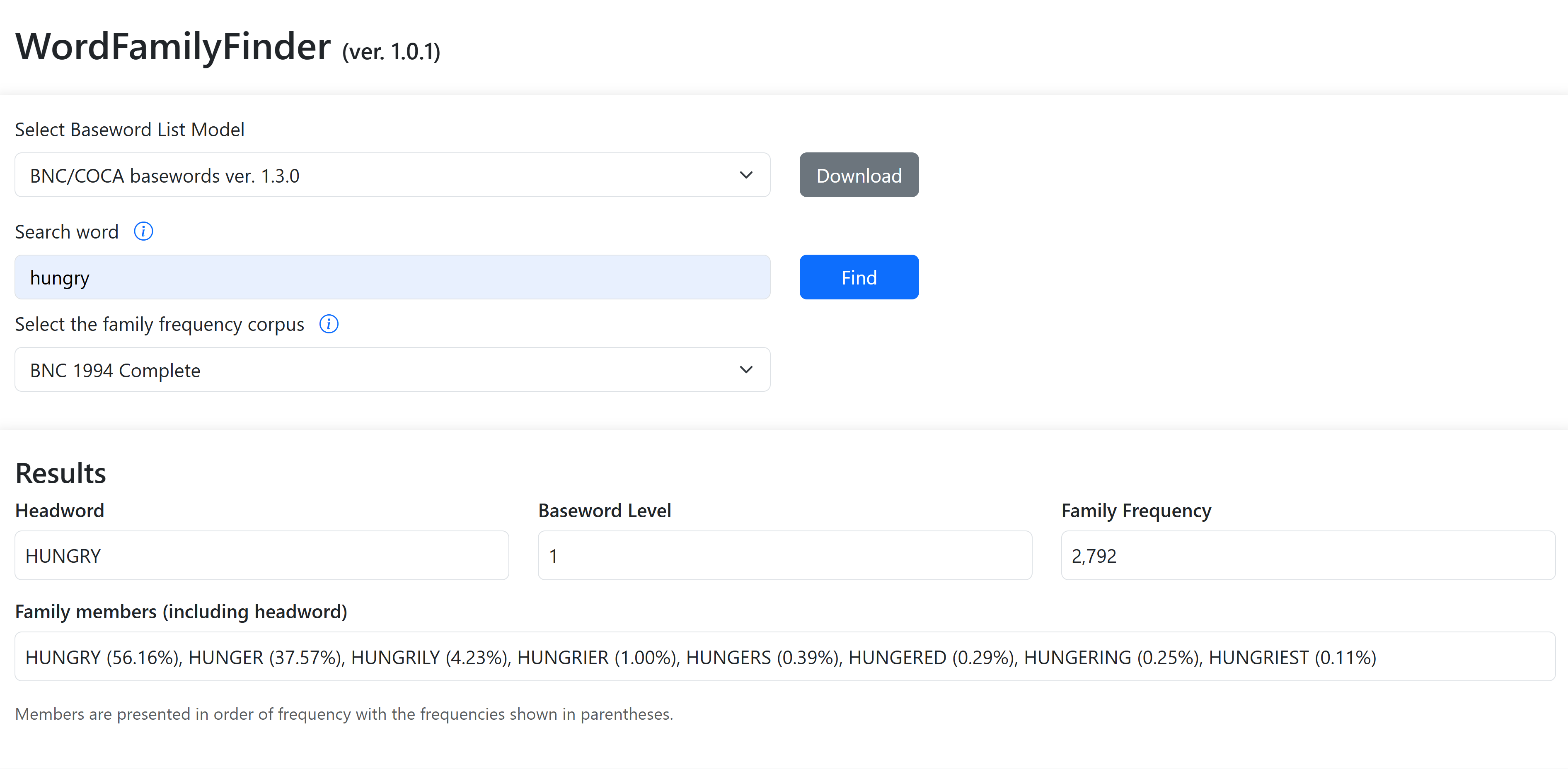
Figure 2 shows the WordFamilyFinder app, which can be used to quickly check the word-family level of a word (1st-1000 frequency band, 2nd-1000 frequency band, and so on up to the 30th-1000 frequency band) to see whether it is worth teaching or studying. The tool includes frequency figures from a 10-million-word corpus, containing 7 million words of spoken English as well as the British National Corpus 1994 (BNC Consortium, 2007). The 30,000-word family lists and the lists of proper names; marginal words, such as swear words; exclamations; letters of the alphabet; transparent compounds, such as “barnyard” and “woodpile,” where the meaning of the parts make up the meaning of the word; and acronyms, such as UNICEF, can also be downloaded from within the app.
Figure 2
Screenshot of WordFamilyFinder, Showing the Entry for “hungry”
WordAffixTrainer
A large proportion of English words contain prefixes and suffixes, and being able to recognize that these words are closely related to other members of the family makes vocabulary learning and guessing from context much easier. As many learners have a poor knowledge of the most important affixes, WordAffixTrainer (see Figure 3) is designed to provide an easy way for learners to quickly become familiar with their form and to recognize them in words.
Figure 3
Screenshot of WordAffixTrainer, Showing a Quiz Item for the Word “brightness” a
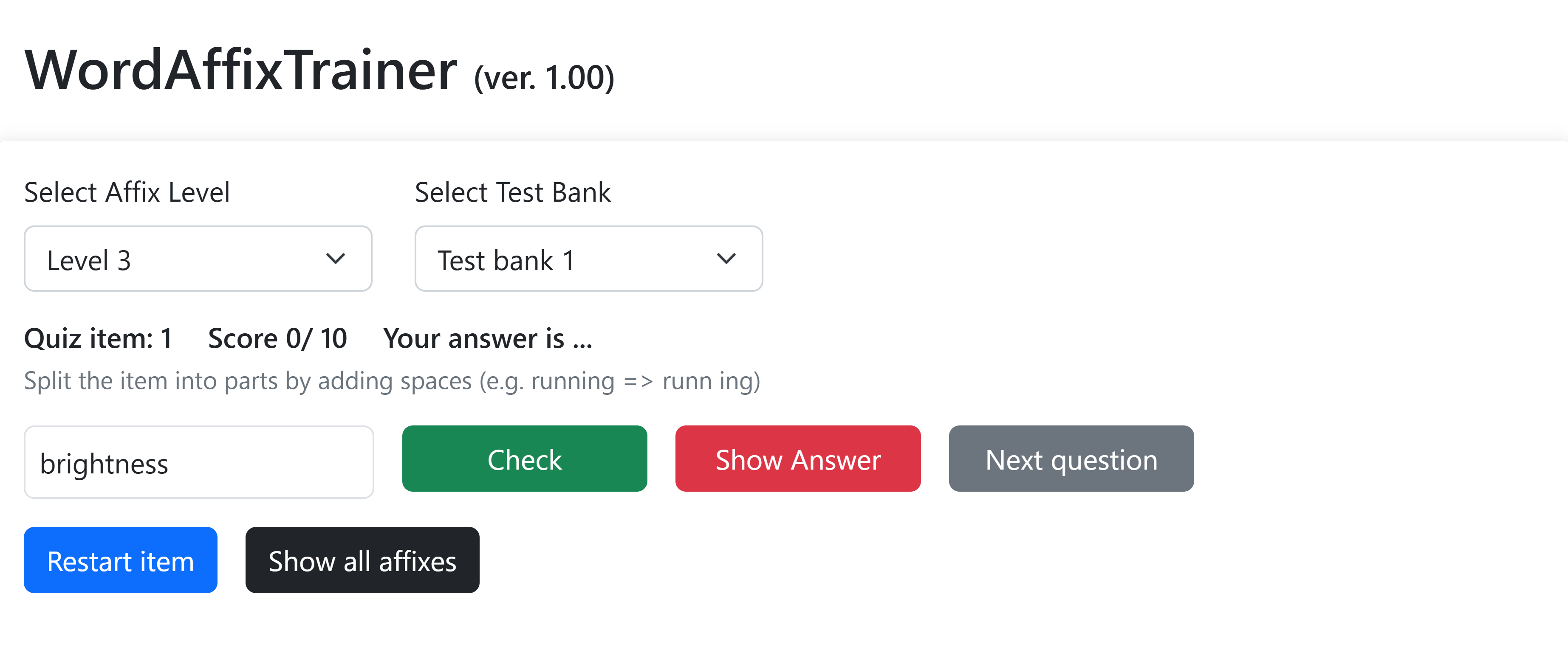
WordAffixTrainer focuses on the most useful English derivational prefixes and suffixes at Levels 3, 4, and 5 of Bauer and Nation (1993). Level 3 consists of the most frequent, regular, productive and predictable derivational affixes, namely the prefixes non-, un-, and the suffixes -able, -er, -ish, -less, -ly, -ness, -th, -y. Level 4 consists of the prefix in and the suffixes-al, -ation, -ess, -ful, -ism, -ist, -ity, -ize, -ment, -ous. Learners have to identify the prefixes and suffixes and separate them from the rest of the word by inserting spaces where necessary. Learners should complete a large number of the short self-checking exercises at each level, especially Level 5 which covers fifty affixes, to make sure that they are well practiced. Based on the affix knowledge generally acquired by learners with different vocabulary sizes, the ten Level 3 affixes should be studied by learners who know around 1,000-2,000 words. The eleven Level 4 affixes should be studied by learners who know around 4,000 words, and the fifty Level 5 affixes by learners who know around 5,000 words (see footnote). For more information about these word parts, see Bauer and Nation (1993) and footnote.
WordStemTrainer
An effective strategy for learning and retaining new vocabulary is to relate unfamiliar words to known words that share the same stem. Word stems may be either free or bound. A free stem can function as a word on its own, such as “safe” in “unsafe” or “safely.” In contrast, a bound stem cannot stand alone with the same meaning, as in “spec” in “inspect.” WordStemTrainer (see Figure 4) is designed to help learners recognize the most useful bound word stems in English. When using WordStemTrainer, learners identify the stem within a word by inserting spaces to separate it from its affixes where necessary. The objective is to recognize the stem itself rather than to analyze affixes in detail. For example, a final “e” is considered part of the stem.
Figure 4
Screenshot of WordStemTrainer, Showing a Quiz Item for the Word “superpower”
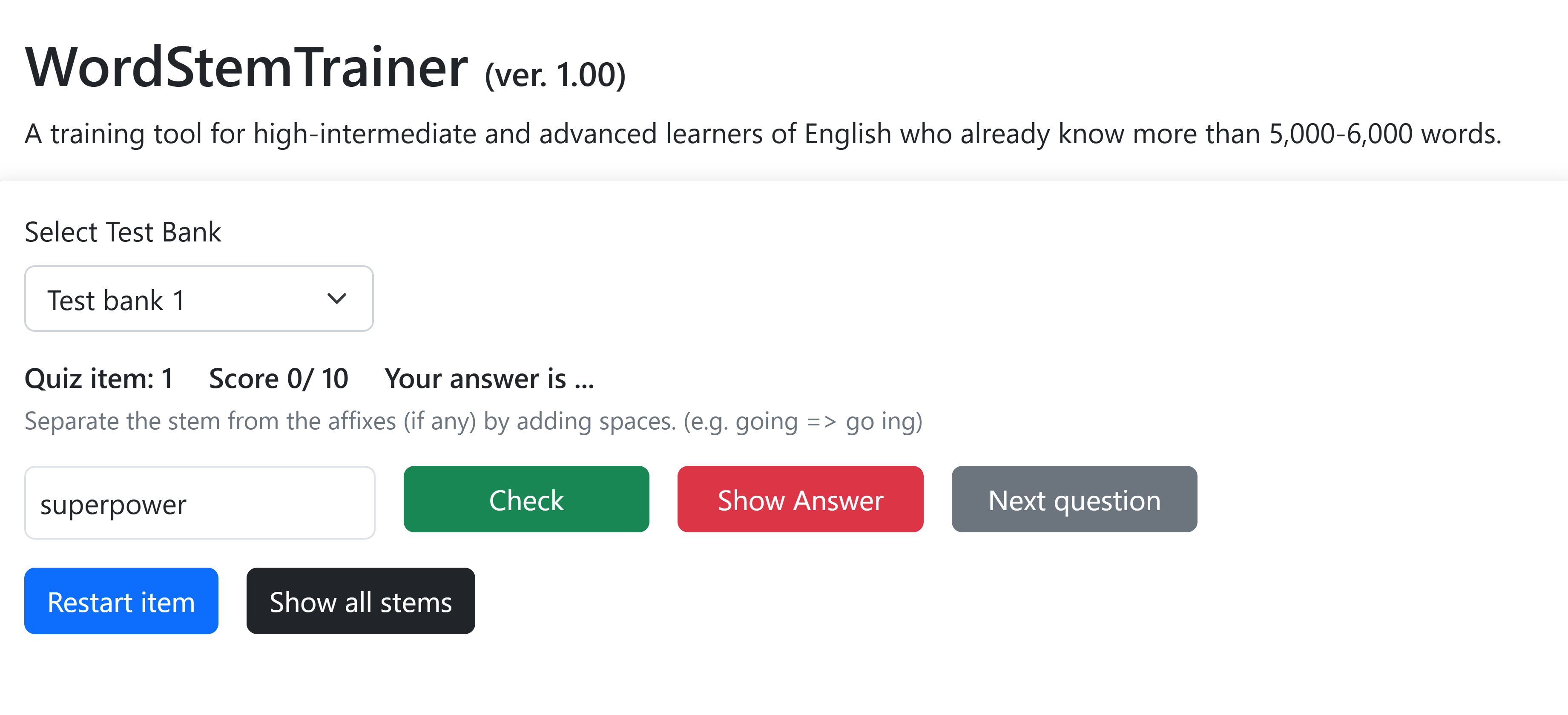
WordStemTrainer is particularly suitable for high-intermediate and advanced learners of English who already possess a vocabulary of approximately 5,000–6,000 words. It may also be beneficial for native speakers who wish to deepen their morphological awareness. The app provides practice in identifying 25 of the most useful English word stems, which typically occur in complex words and do not appear independently. These stems are found within approximately 2,000 different word families in the 3rd to 10th thousand most frequent English words, and all occur within the most frequent 2,000 words of the language. By learning to recognize these stems, learners can enhance their ability to retain and retrieve related vocabulary, thereby strengthening their knowledge of the meanings of these 25 stems. For further discussion of this word-part learning technique, see Wei and Nation (2013).
Conclusion
In summary, the four apps described here address complementary aspects of vocabulary learning and assessment. The Picture Vocabulary Size Test offers a quick and efficient means of measuring learners’ vocabulary size, and it has been successfully used with both young native speakers and EFL learners. The WordFamilyFinder, originally developed to update the BNC/COCA word lists, allows learners to check the frequency level of unfamiliar words and helps teachers determine whether a word is appropriate for classroom focus. Given that many learners struggle with English affixation, the WordAffixTrainer provides a quick, simple, and effective way to develop awareness of common prefixes and suffixes. Finally, the WordStemTrainer supports more advanced learners by developing their knowledge of bound stems and enabling them to use word-part awareness as a mnemonic aid in vocabulary retention.
References
Bauer, L., & Nation, P. (1993). Word families. International Journal of Lexicography, 6(4), 253–279. https://doi.org/10.1093/ijl/6.4.253
BNC Consortium. (2007). British National Corpus 1994, Literary and Linguistic Data Service. https://llds.ling-phil.ox.ac.uk/llds/xmlui/handle/20.500.14106/2554
Wei, Z., & Nation, P. (2013). The word part technique: A very useful vocabulary teaching technique. Modern English Teacher, 22(1), 12–16. https://doi.org/10.26686/wgtn.12543452.v1