
Congratulations—you have nearly finished your research paper. Just one more section to go: the conclusion. It should be easy, right? Just repeat your introduction with a few word changes and call it a day. So why are you still staring at the screen? Hmm … wrapping up your paper in a convincing way is turning out to be harder than it looks.
If you have ever reached the end of a writing pro-ject and struggled to finish strong, take heart—you are not alone. Despite its brevity, the conclusion can be one of the most difficult parts of a paper to write (PLOS, n.d.). One reason for this is the lack of consensus around what exactly a conclusion should contain. According to the Harvard College Writing Center (n.d.), how you conclude depends on factors like the paper’s narrative arc, the conventions of your field, and the stylistic expectations of the journal you are submitting to.
Yet, when done well, a strong conclusion adds considerable value to your work. It synthesizes your key findings, clarifies their broader significance, and leaves the reader with a confident final impression (University of Southern California Libraries, 2025). In short, your conclusion wraps up all your hard work into a tight, purposeful message. Rather than treat it as an afterthought, why not turn it into an asset that elevates the entire quality of your paper?
In this column, I will gather insights from university writing centers, academic writing blogs, and my own writing experiences to highlight a few key takeaways for crafting effective conclusions. First, I will compare conclusions with discussion sections, as the two are often confused. Then, I will outline a few common traps novice writers fall into when wrapping up their papers. Finally, I will share practical strategies for writing strong conclusions, focusing on purpose and structure. Hopefully, by the end of this column, you will have a clearer sense of how to wrap up your next writing project with confidence and clarity.
Discussions Versus Conclusions:
What Goes Where?
One point that has tripped up many academic writers (myself included) is distinguishing clearly between the discussion section of a paper and the conclusion. Because both sections involve interpretation of findings, it is crucial to understand their distinct functions. Doing so can help you avoid blurred boundaries, unnecessary repetition, and a weak ending (R Discovery, 2024).
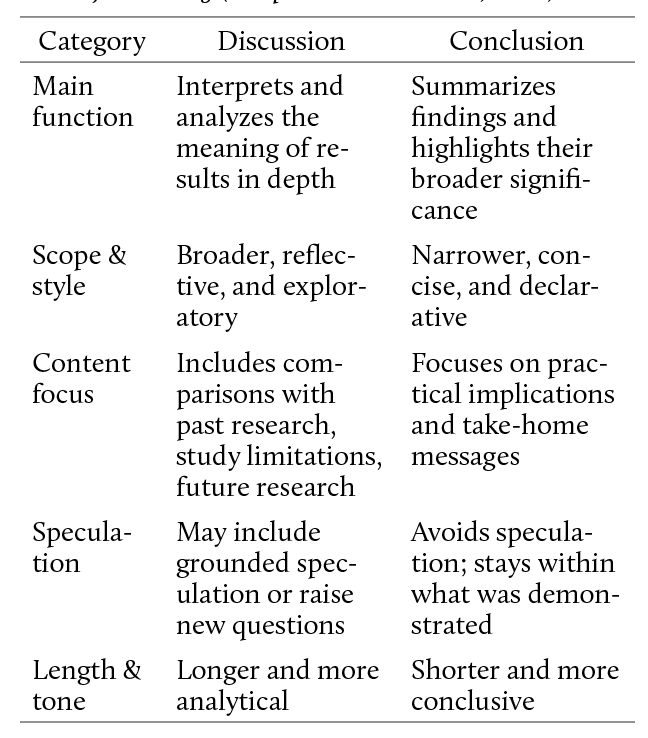
Table 1, based on Castillo (2025), provides a concise summary of the unique but complementary roles these two sections play. Although this comparison is framed around scientific writing, its observations are widely applicable across academic contexts. Even though this framework focuses on scientific writing, it offers a helpful reference point for academic writing more broadly. Perhaps the most important distinction is that the discussion section is where you explore what your results mean. This is your space to engage in reflective, evidence-based interpretation. By contrast, the conclusion focuses on what you can confidently assert based on your findings alone.
As Castillo (2025) emphasizes, the scope of a conclusion should be significantly narrower. You are aiming to present a clear and concise final message, often with a practical focus. It is an opportunity to reinforce key implications and give your reader a lasting takeaway. Whereas the discussion invites speculation and forward-looking questions, the conclusion should avoid extending beyond the evidence already presented. Given its focused nature, the conclusion is typically shorter and written in a declarative tone that signals closure.
Table 1
Comparison of Discussion and Conclusion Sections in Scientific Writing (Adapted From Castillo, 2025)
Conclusion Strategies to Avoid
Even though honing in on what a conclusion should accomplish is a great first step, it is also useful to examine what not to do when wrapping up your paper. Table 2, adapted from the University of North Carolina at Chapel Hill Writing Center (n.d.), presents four predictable traps that even experienced writers can fall into when drafting a conclusion. Although each of these approaches may stem from good intentions, such as wanting to summarize clearly, create suspense, express passion, or squeeze in overlooked material, in academic writing, they tend to backfire.
In the That’s my story, and I’m sticking to it approach from Table 2, the writer merely rehashes the paper’s thesis, offering little or no insight. This is a lost opportunity. Without synthesis or development, the ending falls flat and reads as mechanical or superficial, more like a box-checking exercise than a meaningful conclusion.
The Sherlock Holmes strategy withholds the thesis until the very end, unveiling it for dramatic effect. Even though this technique may work in storytelling or journalism, it violates expectations in academic writing in which readers rely on knowing the main claim early in the paper to guide their understanding.
Table 2
Four Ineffective Conclusion Types (Adapted From the University of North Carolina at Chapel Hill Writing Center, n.d.)
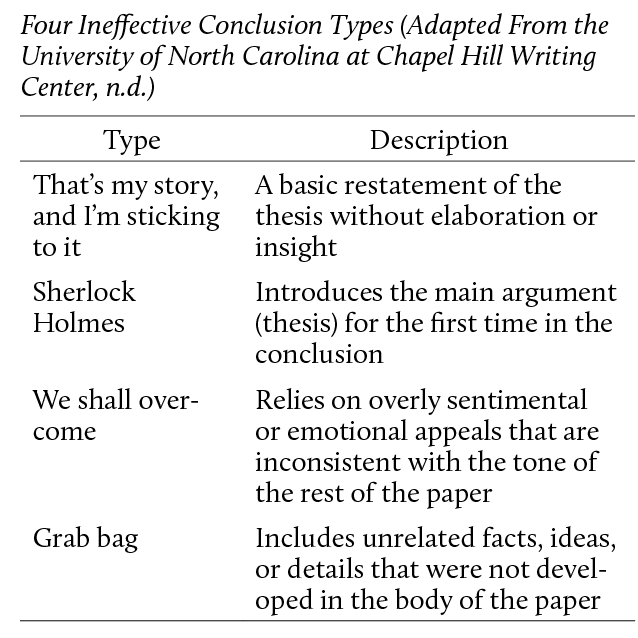
In the We shall overcome type of conclusion, the author appeals strongly to emotion, perhaps to emphasize urgency or commitment. Although heartfelt, this tone often feels out of place in a research context. Academic writing tends to favor reasoned analysis, and emotional appeals may signal uncertainty in the strength of one’s findings.
Lastly, the Grab bag approach crowds the conclusion with new facts, minor points, or loosely related ideas that were not properly developed earlier. This tactic can confuse readers and weaken the paper’s coherence. A strong conclusion does not introduce new information; it synthesizes and closes.
In my opinion, all of these ineffective strategies stem from common sources: a lack of understanding about the purpose of a conclusion, a misplaced desire to entertain or persuade, or simple uncertainty about what one is trying to say. These are paths best avoided. Steering clear of them will help put you on the right track toward ending your paper with clarity, purpose, and strength.
Strategies for Effective Conclusions
Though having a clear understanding of what not to do in a conclusion is helpful, it is equally important to take a more proactive approach by focusing on strategies for ending your paper strongly. The first step is to keep the overall purpose of the conclusion firmly in mind. According to PLOS (n.d.), your main task in this section is to deliver a clear take-home message without overstating the importance of your findings. Avoiding grand, sweeping claims that go beyond what your data can support allows you to present a confident and measured final insight.
In terms of concrete structure, one highly effective way to shape your conclusion is through the What–So what–Now what framework: a flexible, three-part strategy introduced by the Harvard College Writing Center (n.d.). This approach offers a safe and reliable path for restating your key insights, explaining their significance, and offering a final reflection with impact.
Begin with the “what,” which involves clearly restating your paper’s central claim or finding. As Castillo (2025) emphasizes, this part should be concise, focused, and declarative. The goal is not to summarize everything, but to reinforce the key message in light of your full argument.
Next, move into the “so what,” the most critical part of your conclusion. This is where you explain why your findings matter. Do not assume your readers will automatically understand the significance of your results; instead, show them explicitly how your study contributes to the field or addresses a relevant problem. This step transforms your results into meaning.
Finally, end with the “now what:” a brief, forward-looking comment that leaves your reader with something to think about. You might suggest directions for future research, real-world applications, or unanswered questions worth exploring. Reflecting on the following prompts can help generate a strong final statement (Harvard College Writing Center, n.d.):
- What can readers now understand that they could not before?
- What new questions arise from this study?
- What other applications might this research have?
- What action might reasonably follow from this work?
Final Thoughts
As I reach the end of this column, I am reminded of my own approach to writing conclusions. Even though I have generally understood their overall scope and purpose, I must admit that I have at times taken a somewhat cavalier attitude toward wrapping up my papers. By that point in the writing process, I often feel tired and ready to move on. I simply want to be finished, and as a result, I have sometimes defaulted to a box-checking approach. In reflecting on this habit, I now see that I may have missed opportunities to give my readers a stronger send-off. I do believe it matters to put some extra thought and care into this final section. When you manage to stick the landing, it brings about a satisfying feeling, not only for the reader, but for yourself as a writer. You have worked hard on your paper, perhaps for months or even years in the case of larger projects like theses or dissertations. Being aware of the opportunity to tie everything together in a meaningful way is the first step toward making the most of it. Pause. Take a moment to reflect on what you are truly trying to contribute to the world through your work. Let that core message rise to the surface. When it does, you will have the makings of a conclusion that not only finishes your paper, but elevates it. Make your final words count. When you revisit your work later, you will thank yourself for the extra effort.
References
Castillo, M. R. (2025, May 10). Differences between discussion and conclusions in scientific writing. Scientific Writing: Escritura Científica. https://scientificwriting.hcommons.org/2025/05/10/differences-between-di...
Harvard College Writing Center. (n.d.). Conclusions. Harvard University. https://writingcenter.fas.harvard.edu/conclusions
PLOS. (n.d.). How to write discussions and conclusions. https://plos.org/resource/how-to-write-conclusions/
R Discovery. (2024, June 10). Discussion vs conclusion: What is the difference? Researcher.Life. https://researcher.life/blog/article/discussion-vs-conclusion-what-is-th...
The University of North Carolina at Chapel Hill. (n.d.). Conclusions. Writing Center: University of North Carolina at Chapel Hill. https://writingcenter.unc.edu/tips-and-tools/conclusions/
University of Southern California. 9. The conclusion: Organizing your social sciences research paper. USC Libraries. https://libguides.usc.edu/writingguide/conclusion