[Eleanor Kane Hinohara. Nagoya. Perceptia Press. 2023. p. 132. ¥2,970. (Teacher’s Guide and Audio tracks are available on the publisher’s website.) ISBN: 978-4-911164099.]
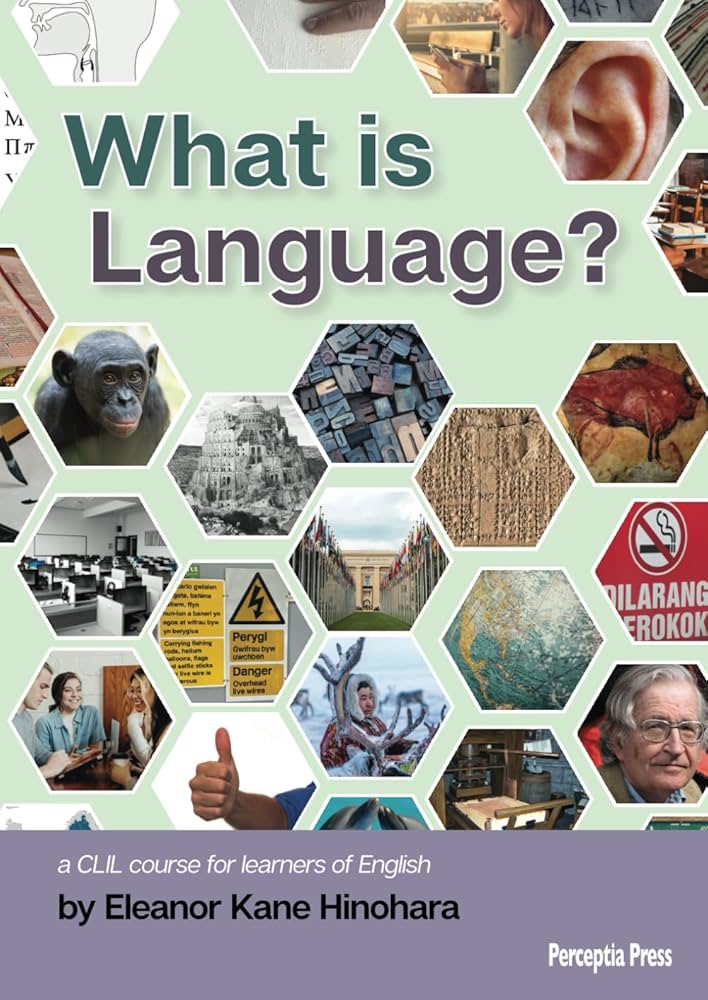
Anyone teaching a content and language integrated learning-style (CLIL) course to introduce a range of topics on linguistics should consider using What is Language? I used it for a one-semester seminar with second-year university students (CEFR A2 to B1) and found it effective. The book focuses on delivering the content through the skills of reading of text and visual data, along with discussion, presentation, and some listening. The main challenge was deciding what to omit, as we had time to cover only nine of the 15 units.
The 15 units follow a consistent structure, progressing from fundamental topics, such as what comprises a language and the origin of writing, to what the back cover correctly claims are “more cognitively demanding topics, such as language policy.” Each unit consists of eight pages of exercises and activities that build engagement and understanding. The extensive bibliography and suggested further reading for each topic highlight the comprehensive underpinning of the content.
As an example, Unit 2 (How Many Languages Are There?) starts with the Interviewing your Classmates section, where students write their answers in a table to five accessible questions, such as, “how many languages do you speak,” and “why do you think some languages are in danger?” (p. 14). Then, they interview two classmates. This activity successfully got my students to start thinking and actively talking about the topic. The table gives plenty of space for students to write in, which textbooks often frustratingly do not. Below the table are several blank lines, where students take notes while listening to the book’s author asking the same questions to a native or otherwise proficient speaker of English. The interviews sound natural and the interviewees have an engaging variety of voices and accents.
Next is the Key Vocabulary section, presented through interactive tasks rather than simple lists. Students complete sentences using phrases from a pie chart and label a map. The core of the unit follows on the next two pages in a reading of nearly 700 words. Readers first scan for three main ideas and then answer five more detailed comprehension questions. I was concerned that my students would find the readings and questions too laborious, so I often adjusted the sequence of activities by going through the later vocabulary from the Academic Word List section between the reading tasks. This page always made a good homework task, which students checked together at the beginning of the next class. The words taken from the New Academic Wordlist (Coxhead, 2000) in that section appear in the reading. In this unit, they are presented in a gap-fill activity. The Analyzing Data section follows, in which students need to answer questions about the loss of languages around the world by interpreting graphs.
The penultimate section, Academic Language Skills, requires students to research and then share information about “last speakers of a language” (p. 20). On the last page of each unit, students write guided notes on their classmates’ presentations about the topic so that they are ready to give peer feedback. Though I did not use this section due to time constraints, I kept one class near the end of the course for presentations using a simple framework. The book also includes a detailed rubric for presentations at the back of the book, perhaps useful for courses where presentations play a larger role in grading. Instead, I mostly assessed students through weekly coursework and quizzes that I made in Google Forms to review the content.
I also used Google Forms to ask the students what they thought of the textbook. They all found the content interesting and particularly liked the various vocabulary learning sections, as well as those asking them to analyze data and interview each other. Most of the students responded that the readings were about the right length and difficulty although they have been more of a challenge for students clearly below what the publisher’s website states as its target (B2–C2).
In addition, parts of the reading on men and women’s language seemed biased: Cameron’s (2007) argument that the language of men and women—especially in the workplace—is largely the same is rightly acknowledged, whereas Tannen’s (2007) observations on differences in communication styles in personal lives is not mentioned.
Overall, the book is a well-structured, engaging resource for introducing important topics in linguistics while reinforcing academic reading skills. Ideally, it is better suited to a year-long course, although I enjoyed the flexibility it offers even for one semester.
References
Cameron, D. (2007). The myth of Mars and Venus: Do men and women really speak different languages? Oxford University Press.
Coxhead, A. (2000). A new academic word list. TESOL Quarterly, 34(2), 213–238. https://doi.org/10.2307/3587951
Tannen, D. (2007). You just don’t understand: Men and women in conversation. Harper Collins.