
Recent developments and investments within artificial intelligence (AI) technology and the rate and scale at which they occur suggest that the technology will become a staple in many fields in the coming years, including education (Duggan, 2025; Wheeler, 2025). For educators, the question is no longer one of “should AI be used within the classroom?”, rather “how should we use AI in the classroom in a meaningful way to support learning goals?” Answers vary, of course, but there is an exciting and rapidly growing body of empirical studies exploring AI use within an EFL classroom (Zhou & Hou, 2025), and language teachers around the world are sharing their creative applications of this tech with one another (Kundu & Bej, 2025).
It is in this spirit that I would like to share one particular use of the tech that I found beneficial in the secondary EFL classroom, which is utilizing generative AI for language test preparation. As teachers know all too well, creating material is time consuming, and test preparation is no exception. Although I would never argue for AI replacing human created materials, I began to wonder whether AI could assist in randomly generated test practice questions. To my surprise, it works quite well and has saved me quite a bit of time. I found one particularly useful function that can then be applied to a range of activities, which I will showcase below, depending on the teacher’s situation and requirements.
The primary function of using AI is to generate test questions in accordance with specific criteria. The goal is to reduce the time it takes to prepare such questions for standardized language tests (EIKEN, IELTS, TOEIC, etc.), and I found that, with the correct prompts, Microsoft’s Copilot AI tool, which can be found at copilot.microsoft.com, works quite well. This tool was chosen, as it is freely available to anyone with no additional download required. Also, it uses the latest GPT 5 (as of August 2025), and the tool is likely to be continuously updated. When choosing a tool, two key considerations should be kept in mind, namely ease of access and clear user interface. Previously, bespoke solutions were required (such as Quizlet, Duolingo, etc.), but these often had several barriers to entry. Price, account set-up, and learning the proprietary AI are all significant hurdles for learners; these issues are multiplied for younger learners and/or those working with limited English ability.
AI Prompts
The following prompts are what I used to generate language test questions, but they can also be pasted into the students’ learner management systems, allowing students to copy and paste it into Copilot and be powered by their own unique questions:
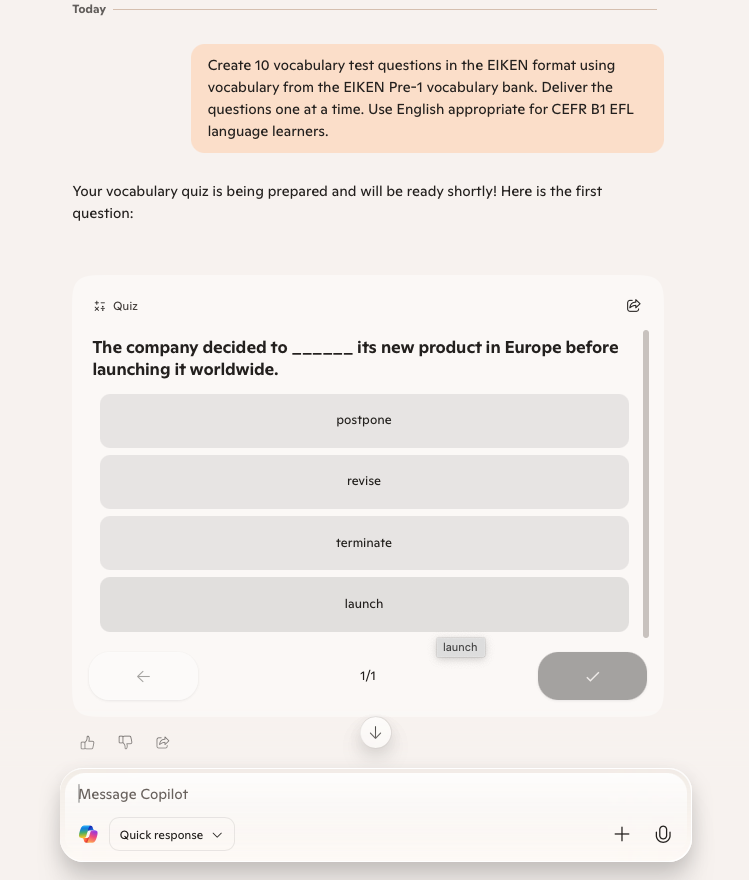
Create 10 vocabulary test questions in the EIKEN format using vocabulary from the EIKEN Pre-1 vocabulary bank. Deliver the questions one at a time. Use English appropriate for CEFR B1 EFL language learners (Underlined variables can be changed as desired).
Once the questions are generated (see Figure 1), they can be expanded into several activities. For context, all activities were used at the senior high school level in a classroom of 32 EFL learners at approximately CEFR A2 or lower B1 level. However, they can be adapted to any proficiency level with ease.
Figure 1
Screenshot of Microsoft Copilot Showing the Prompts Input by the User and the AI’s Response
Activity 1: Class quizzes
Quizzes generated by either the teacher or students can be given in class at any stage of the lesson, and students can keep record of their scores. Incorrect answers can be written into any vocabulary notebook that students may have, and as each quiz is different, answers can be collated across the whole class to facilitate student-to-student learning as well. The value in using AI for this activity is that it can generate unique questions in seconds, so each student’s quiz can be bespoke. Additionally, students can be encouraged to take these mini quizzes several times a day as the test date draws closer.
Activity 2: Pair Quiz
The second activity is a simple variation of the solo quiz, whereby pairs of students quiz one another by reading the question and answering out loud. As Copilot supports verbal prompts, students can also quiz the AI and compare answers.
Activity 3: Reverse Quiz
Another common exercise is the reverse quiz, whereby the quiz answers can be used to increase the challenge. In this format, Student A will read the answer to Student B, and Student B needs to write (or say) their own example sentence using the word. Then, students can use AI prompts to compare their example sentence with what AI generates.
Activity 4: Definition Challenge
AI-generated quiz sentences can also be used as models for students to deduce the general meaning of the target vocabulary item, rather than picking out the correct word from an answer bank. Depending on the desired focus, this can be done in either Japanese or English.
Cautionary Notes
For as beneficial as a time saving tool AI has become, teachers do need to check the questions and answers for possible errors (aka hallucinations), as generative AI still makes mistakes and tends to confidently state these mistakes as facts (Jones, 2025). Teachers need to monitor and be on-hand to give students succinct, appropriate support and guidance in using AI where necessary.
To conclude, I hope my use of AI for language test preparation can be of some use. Although educators are always finding new and interesting ways to utilise AI to support student learning every day, articles related to AI’s ability to create language-specific test questions are scarce. The growing body of research and AI applications within education technology is very exciting, and it will be fascinating to see how language learning classrooms evolve over the next few years.
References
Duggan, W. (2025, September 3). Artificial intelligence stocks: The 10 best AI companies. U.S. News. https://money.usnews.com/investing/articles/artificial-intelligence-stoc...
Jones, N. (2025, January 21). AI hallucinations can’t be stopped: But these techniques can limit their damage. Nature. https://www.nature.com/articles/d41586-025-00068-5
Kundu, A., & Bej, T. (2025). Transforming EFL teaching with AI: A systematic review of empirical studies. International Journal of Artificial Intelligence in Education, 1–34. https://doi.org/10.1007/s40593-025-00470-0
Wheeler, K. (2025, June 4). Top 10: Companies investing in AI. AI Magazine. https://aimagazine.com/top10/top-10-companies-investing-in-ai
Zhou, C., & Hou, F. (2024). Can AI empower L2 education? Exploring its influence on the behavioural, cognitive and emotional engagement of EFL teachers and language learners. European Journal of Education, 59(4), 1–13. https://doi.org/10.1111/ejed.12750