
If you are new to academic writing and find the discussion section of your research paper particularly vexing, you are not alone. This section—an essential component of academic journal articles, book chapters, and dissertations—is widely regarded by authors and editors as one of the most difficult parts to write (Nundy et al., 2022).
It is easy to see why. In the discussion, your job is not just to summarize your results, but to interpret them in relation to your research questions and the existing literature (Vieira et al., 2019). In other words, you must explain what your results mean, why they matter, and how they fit into the bigger picture, all while ensuring clarity for the average reader (Hess, 2004). By doing so, you demonstrate your understanding of the broader scholarly conversation and establish how your research contributes to it (McCombes, 2025).
To help you navigate the complexities of writing an effective discussion section, I will start by highlighting common pitfalls that writers—both novice and experienced—often encounter. These are well-documented mistakes, frequently discussed in how-to guides, university writing center resources, and scholarly articles. Once we have covered what not to do, I will introduce a rubric to evaluate a tried-and-true rhetorical structure. This will help you assess your own writing and analyze discussion sections in target journal articles, giving you a clearer sense of what makes them effective.
Common Discussion Section Pitfalls
When tackling any challenge, it helps to first consider what not to do. Below is a concise, non-exhaustive list of six common pitfalls that writers often encounter when discussing their research findings—mistakes frequently highlighted in the literature on this topic.
Simply Restating Results
One common mistake among novice academic writers is rehashing findings already presented in the results section. Instead of interpreting their results and addressing the all-important “so what?” question, authors provide little analysis or commentary. As a result, the discussion section falls flat, leaving readers uncertain about the significance of the findings—or why they should care. Avoid turning your discussion into a second results section; instead, focus on explaining and evaluating your findings, building an argument that supports your overall conclusion (McCombes, 2025).
Introducing New or Unnecessary Information
Another frequent pitfall is introducing new data or extraneous details. This violates expected conventions and weakens the clarity of key insights. Results belong in the results section—adding more data here distracts from analysis and confuses the reader (Thomson, 2023). Similarly, veering off into unrelated issues makes it harder for readers to grasp the study’s main takeaways (Hess, 2004). To avoid this, stay laser-focused on your primary message, ensuring every point reinforces your study’s key insights.
Weak Integration of Previous Research
Failing to integrate previous research into your discussion is a common pitfall among academic writers. One of the main purposes of the discussion section is to situate your findings within the existing literature (Dunton, 2021). When this step is overlooked, it isolates your paper, making its significance within the broader field unclear (Charles Darwin University, n.d.). Effectively comparing and contrasting your findings with past research strengthens your interpretations and assertions, making for a more compelling and well-supported discussion (Solid Research Group, n.d.).
Overgeneralizing or Misrepresenting Findings
When discussing your research, be careful not to overgeneralize or misrepresent your findings. This occurs when claims go beyond what the data supports—a serious mistake that can frustrate reviewers and mislead readers (Hess, 2004). One common cause is viewing the discussion section as a way to “sell the paper” (Skelton & Edwards, 2000, p. 1269) through rhetoric and speculation rather than grounded analysis. This pitfall can be tricky to avoid, as interpreting results is inherently subjective—yet overinterpretation weakens credibility (Sacred Heart University Library, n.d.). Stay vigilant and ensure your analysis remains firmly rooted in your data.
Not Mentioning Your Study’s Limitations
Failing to acknowledge problems or limitations in your study weakens its overall credibility. No research is perfect—there are always constraints that should be addressed (Hess, 2004). For example, you may have had a small sample size, low or inconsistent response rates, or an uncontrolled confounding variable (McCombes, 2025). While revealing weaknesses may seem counterintuitive, doing so demonstrates honesty, integrity, and critical engagement with your work (PapersOwl, 2024). If you fail to mention limitations, reviewers certainly will (Vieira et al., 2019). Instead of avoiding them, frame limitations as opportunities for future research, turning potential weaknesses into constructive next steps (Taherdoost, 2022).
Lack of Structure and Logical Flow
A final pitfall I will highlight is the lack of clear structure and logical flow in discussion sections. Instead of smoothly progressing from one point to the next, some authors jump randomly between ideas, creating a disorganized mix of unrelated information that is difficult to follow (Nundy et al., 2022). This often stems from a lack of understanding of how to structure prose in a way that conveys a clear, cohesive message (Şanlı et al., 2013).
In fact, many of the pitfalls discussed in this column trace back to this fundamental issue: structural awareness. Without a strong grasp of discussion section conventions, writers struggle to organize their ideas, integrate research effectively, and maintain logical flow. In the next section, I will introduce a structured approach that will help you assess and improve your discussion writing.
A Framework for Assessing Discussion Sections
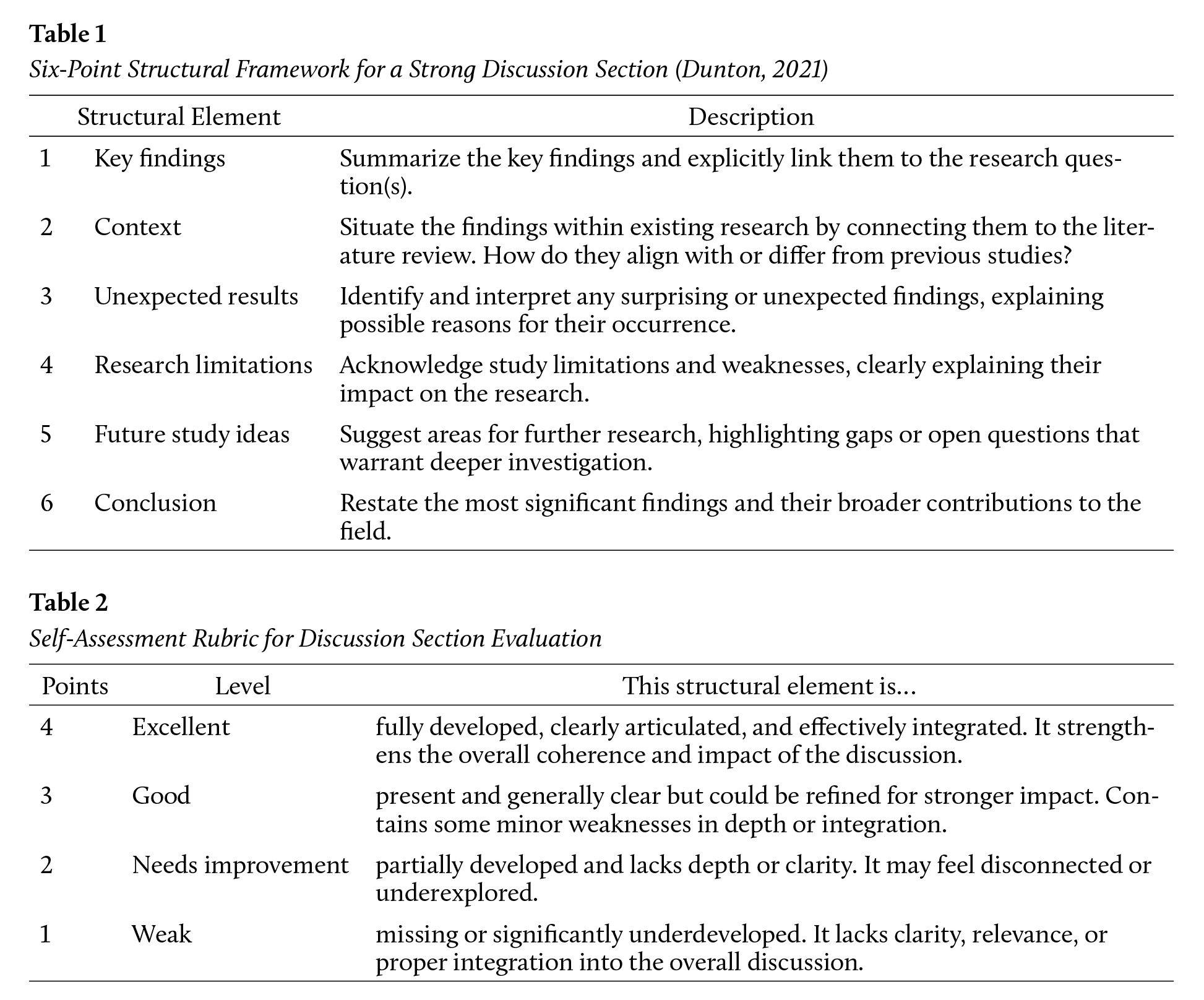
Now that we have covered what not to do when discussing research findings, let’s shift toward a constructive approach using a tried-and-true structural formula. Even though there is no single best way to organize a discussion section—as styles vary by discipline and subject—the six-point framework from Dunton (2021) provides an excellent foundation, particularly for research involving the collection and analysis of qualitative or quantitative data (see Table 1).
To develop a deeper understanding of this structure, Dunton (2021) suggests applying this framework not only to your own writing, but also to analyze discussion sections in articles from your field. This is an excellent idea, so to help you, I have created the following rubric (see Table 2).
Apply this rating scale to each element in a discussion section from a paper you have written and reflect on its effectiveness. For example, start with how you have presented your key findings. Are they fully developed and clearly articulated, or are there any minor weaknesses, such as a lack of depth or integration? Score each section, then total your points. If your score is in the 20s (Good+), you are doing well, but see if you can identify specific areas for improvement. To strengthen those areas, follow up with further reading and study (the references in this article are a great place to start).
Next, take this analysis a step further by using the rubric to evaluate published articles in a journal you are targeting for publication. For example, if you are aiming to publish a Featured Article in The Language Teacher, examine past articles in the TLT archives (https://jalt-publications.org/tlt/archive). How do those discussion sections compare? What insights can you apply to your own writing? Deeply reading articles from your target journal is one of the best ways to internalize its style and tone.
Final Thoughts
In this column, I have provided a brief overview of what it takes to write a strong discussion section—first by highlighting common pitfalls, then by introducing a structured framework to help ensure you are covering all key elements. As you actively reflect on your writing and analyze published discussions, your experience and confidence will grow, allowing you to craft more complex and sophisticated analysis.
As a former journal editor, I can say with confidence that your chances of getting published increase significantly when your submission aligns with the journal’s expectations. A big part of meeting that expectation is learning to interpret and communicate your findings effectively. Taking the time to analyze discussion sections you have written and from your target journal will help you present your research as a natural fit—a key factor in successful academic publishing.
References
Charles Darwin University. (n.d.). Writing a discussion section. https://www.cdu.edu.au/library/language-and-learning-support/study-skill...
Dunton, R. (2021). Discussion section for research papers. San José State University Writing Center. https://www.sjsu.edu/writingcenter/docs/handouts/Discussion%20Section%20...
Hess, D. R. (2004). How to write an effective discussion. Respiratory care, 49(10), 1238–1241. https://doi.org/10.4187/respcare.04491238
McCombes, S. (2025, January 14). How to write a discussion section: Tips & examples. Scribbr. https://www.scribbr.com/dissertation/discussion/
Nundy, S., Kakar, A. K., & Bhutta, Z. A. (2022). How to write the discussion? In S. Nundy, A. Kakar, & Z. A. Bhutta (Eds.), How to practice academic medicine and publish from developing countries? A practical guide (pp. 225–230). Springer. https://doi.org/10.1007/978-981-16-5248-6_21
PapersOwl. (2024, September 23). How to write a discussion section of a research paper? https://papersowl.com/blog/how-to-write-a-discussion-section-of-a-resear...
Sacred Heart University Library. (n.d.). Organizing academic research papers: 8. the discussion. Sacred Heart University. https://library.sacredheart.edu/c.php?g=29803&p=185933
Şanlı, Ö., Erdem, S., & Tefik, T. (2013). How to write a discussion section? Turkish Journal of Urology, 39(Suppl. 1), 20–24. https://pmc.ncbi.nlm.nih.gov/articles/PMC4548568/
Skelton, J. R., & Edwards, S. J. (2000). The function of the discussion section in academic medical writing. British Medical Journal, 320(7244), 1269–1270. https://pubmed.ncbi.nlm.nih.gov/10797045/
Solid Research Group. (n.d.). Common pitfalls when writing a paper’s discussion section.
https://solidresearchgroup.com/common-pitfalls-when-writing-a-papers-
discussion-section/
Taherdoost, H. (2022). How to write an effective discussion in a research paper: A guide to writing the discussion section of a research article. Open Access Journal of Addiction and Psychology, 5(2). 1–3. https://doi.org/10.33552/OAJAP.2022.05.000609
Thomson, P. (2023, April 22). Five discussion chapter challenges. Patter. https://patthomson.net/2023/04/22/five-discussion-chapter-challenges/
Vieira, R. F., de Lima, R. C., & Mizubuti, E. S. G. (2019). How to write the discussion section of a scientific article. Acta Scientiarum: Agronomy, 41, 1–11. https://www.scielo.br/j/asagr/a/NQFFcLfhFnpMS6KgFk6HGpk/?lang=en