
[LeBeau Charles. Tokyo: Cengage Learning, 2021. p. 128. ¥ 2,800. (Teacher’s manual available.) ISBN: 978-4-86312-385-4.]
Reviewed by Joyce Dong, JALT Fukuoka
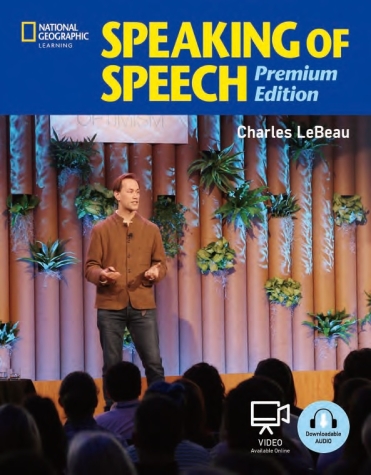
Speaking of Speech, Premium Edition: Basic Presentation Skills for Beginners is an introductory presentation textbook that explains the principles of presentation in four key messages: the Physical Message, the Visual Message, the Story Message, and the Verbal Message. Instructors teaching students of different majors may be pleased to find the presentation topics both engaging and applicable to students of pre-intermediate to intermediate levels. I used this textbook in a beginner presentation course for commerce students focusing on essential presentation skills before assigning them commerce-related topics. The textbook is easy to use and is attractive with glossy images and illustrations. Instructors would find the sample syllabus beneficial and adaptable for their own classes lasting eight, 15, or 30 lessons.
A key strength of Speaking of Speech is its ability to captivate non-native students’ interests in the non-verbal, physical, and visual messages. The textbook starts with the non-verbal skills of the physical message, which got the students quickly engaged. My students enjoyed the making eye contact activities, before adding gestures for emphasis. For the visual message, instead of just telling students what a good PowerPoint slide was, the practice of analyzing PowerPoint slides to identify the problems and solutions on how to improve them, made students think more critically about slide design and layouts. Each unit was accompanied by a section highlighting the common pitfalls made in slide design, which was useful to reinforce the visual message to students on a regular basis.
Speaking of Speech is accompanied by an instructor-friendly teacher’s manual with practical recommendations. The appendix gives instructors ideas on how to conduct presentations, how to conduct peer feedback, and how to arrange classroom logistics for performances and tips for visuals. The manual also offers challenges for higher ability students (under the One Step Beyond section). In this premium edition, the author has included valuable teaching tips for instructors. However, it would have been great if the sample tests could be digitalized and included on a language learning platform for quick scoring purposes. Online quizzes would likely be well-received by instructors and students alike.
As Brooks and Wilson (2014) state, teachers should be cognizant that most students are unfamiliar with the key features of oral presentations and that they need to provide students with ample scaffolding. The re-shot and updated presentation videos, along with the scaffolding steps detailed in the Performance section, provide students with a good understanding of the presentation process. After watching the videos, in the Model Presentation section of the textbook, students are prompted to pay attention to not just the content of the videos, but also the skills used in the presentation delivery.
Although most of my students found the model videos engaging and entertaining, some students commented that they were “contrived” and “slightly over-the-top.” The overall filming direction seems geared towards injecting humor rather than realism into the presentations. The video felt like they were more like acting performances rather than actual presentations. It might be good to strike a balance between being interesting and realistic by including authentic examples of student presentations.
This textbook could also have highlighted cross-cultural differences in gestures to make it culturally nuanced. During the pair activity in which gestures are added to sentences, (e.g., “We want to cut cost,”) I noticed cultural variations in gesturing. In addition to the verb “cut,” some students gestured “cost” or “money” in a Japanese way, which differed from the western approach. As languages differ in how they express concepts lexically and syntactically, this could lead to variations in gestures, such as choosing either a single gesture or two separate gestures (Kita, 2009).
Instructors may also find that they need to make an additional effort to teach students how to deliver the verbal message, beyond the focus on voice inflections in Unit 3. Many L2 students lack “core fluency” (Jordan, 1997, as cited in Brooks & Wilson, 2014, p. 203), and without targeted instruction in skills like chunk reading, low-proficiency L2 students may struggle to present successfully. Kosaka (2024) found that they were less sensitive to the syntactic and semantic information of multiword units compared to their first language (L1) counterparts (p. 3). Therefore, including a section focused on chunk reading with video or audio examples—not just in the appendix, but also in the main textbook—would be helpful.
Overall, Speaking of Speech is a good start to introduce students to the four messages of a presentation. Most of my students liked the textbook and said it was easy to understand even though there were only English instructions. Instructors would find this textbook useful to make presentations fun and relevant in English classes.
References
Brooks, G., & Wilson, J. (2014). Using oral presentations to improve students’ English language skills. Kwansei Gakuin University Humanities Review, 19, 199–212. www.researchgate.net/publication/324217578_Using_oral_presentations_to_i...’_English_language_skills
Kita, S. (2009). Cross-cultural variation of speech-accompanying gesture: A review. Language and Cognitive Processes, 24(2), 145–167. https://doi.org/10.1080/01690960802586188
Kosaka, T. (2024). The effects of chunk reading strategy training on the word chunking skills of L1-Japanese English learners. System, 126, 1–16. doi.org/10.1016/j.system.2024.103495