
Listening comprehension is a fundamental skill in language acquisition, and is perhaps one of the most important for language students (Rost, 2011). Despite its importance, listening often receives less instructional time than reading, writing, and speaking in many language classrooms. Teachers frequently prioritize speaking and grammar-based lessons, leaving students with insufficient practice in processing spoken language (Field, 2009). Even when listening activities are included, they often involve passive listening to scripted dialogues, which do not reflect the variability and complexity of real-world spoken language. Furthermore, listening activities are not always time efficient. Traditional approaches, such as playing an entire recording followed by comprehension questions, may not optimize students’ exposure to key vocabulary and structures. Instead of meaningful engagement, students may spend a disproportionate amount of time struggling with unfamiliar accents, rapid speech, or unclear audio quality. While there are numerous audio resources available online, teachers often struggle to find targeted examples of specific words and phrases in authentic contexts. The audio components of textbooks tend to be long; many of the audio exercises in textbooks used by this author exceed 4 or 5 minutes. This can be especially difficult for lower-level learners, not only because of the large amount of information, but also in how different such segments are from a natural conversation with shorter segments of speech, pauses, speaker changes, etc. (Ur, 2016). This article will focus on the benefits and drawbacks of the adoption of YouGlish to address the above issues in the context of a Japanese university.
Using YouGlish to Generate Shorter and More Specific Segments
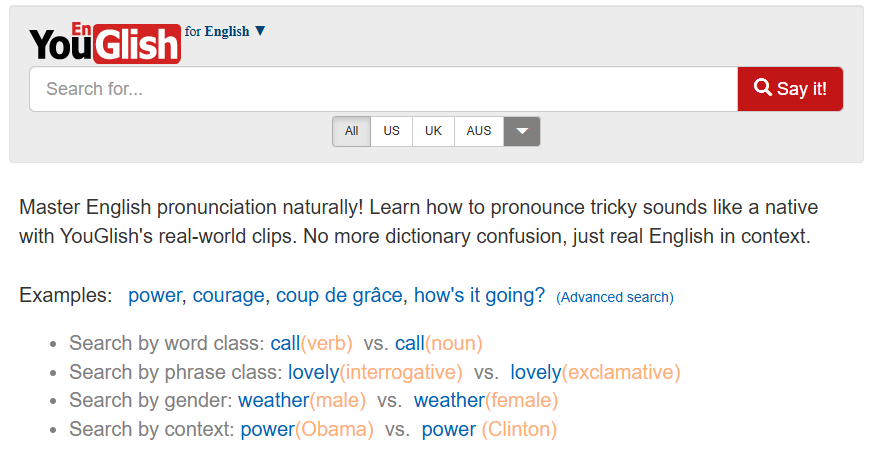
YouGlish.com, a video search engine that provides video-based examples of words and phrases in real speech, offers a solution (see Figure 1). Words can be searched by regional accent (US, UK, Australian, etc.), word class, phrase form, topic, context, and a speaker’s gender. This allows for highly specific searches that help learners focus on key vocabulary in context.
By filtering searches by part of speech, accent, and sentence type, teachers can ensure students receive exposure to the language in varied, authentic settings. This specificity aids comprehension by reinforcing how words function within a variety of grammatical structures. This differs from the usual approach many textbooks use of pre-teaching vocabulary terms and including an audio file which may contain each word a single time—a practice found to be less effective than other methods (Chang & Read, 2006). Additionally, exposure to multiple speakers prevents students from becoming overly reliant on a single voice or accent, an issue often found in traditional textbook audio recordings.
Figure 1
A Variety of Available Search Criteria
Benefits and Drawbacks
One of the primary benefits of using YouGlish is the ability to provide learners with authentic language input in a manageable format. Unlike traditional listening exercises that may feature lengthy dialogues, YouGlish allows teachers to break content into smaller, more comprehensible segments, reducing cognitive overload and helping lower-level learners focus on key aspects of pronunciation, word usage, and sentence structure. This approach aligns with Nation’s (2013) assertion that repeated exposure to vocabulary in varied, meaningful contexts enhances retention and deepens students’ understanding of word usage.
However, there are also drawbacks to using You-Glish. As the tool relies on an extensive database of publicly available videos, some clips may contain unclear audio, strong regional accents, or additional vocabulary that is too advanced for lower-level learners. Another challenge is the lack of subtitles in some videos, which can make comprehension difficult for students who rely on written support. Finally, because many of the videos are sourced from public speaking presentations (such as TED Talks), the topics can sometimes be rather boring for students. Nevertheless, these issues can be mitigated by strategically selecting and scaffolding activities around the chosen content, properly selecting clips that align with instructional goals and the target audience.
Classroom Observations
YouGlish can be used in various ways, offering flexibility in classroom settings. In this author’s experience, one of the most effective methods has been integrating YouGlish into paired or group dictation exercises. Students are given a set of vocabulary words to listen for, and as they hear them in video clips they transcribe these words or phrases. This approach aligns with findings that demonstrated that frequent dictation enhances listening comprehension in EFL learners (Kiany & Shiramiry, 2002). Another method involves students predicting a word’s usage before watching videos. For example, after introducing the term “sustainability,” students are asked to guess how it will be used before searching for examples on YouGlish. This has led to increased engagement, as students actively anticipate language structures. Additionally, incorporating accent recognition into activities has proven to be a fun and educational component. Students often enjoy the challenge of distinguishing between American, British, and Australian accents, further refining their listening skills. Initial student reactions to YouGlish were mixed: some students found the interface overwhelming due to the vast number of search results, while others appreciated the control over playback speed and repetition. Over time, students became more comfortable with the tool, particularly after guided practice sessions. The lack of subtitles in some videos was initially a challenge; this was mitigated by selecting clips with clear articulation and pausing videos for discussion. In the long term, students reported greater confidence in understanding spoken English, particularly in recognizing words in natural speech rather than relying on scripted dialogues.
Conclusion
YouGlish offers a valuable resource for enhancing listening instruction in the language classroom. By allowing learners to engage with shorter, contextually relevant speech samples, it helps bridge the gap between artificial textbook recordings and real-world spoken language. Furthermore, it promotes the development of vocabulary acquisition, pronunciation awareness, and comprehension of various English accents. Student feedback suggests that while initial exposure to the tool can be overwhelming, familiarity with its features and guided exercises contribute to a more positive and productive learning experience over time. While some limitations exist, such as unclear audio or potentially advanced vocabulary, these challenges can be addressed through careful selection of clips and structured scaffolding. The flexibility of YouGlish enables it to be integrated into various classroom activities, from dictation to accent identification exercises. Future research could explore its long-term effects on listening proficiency and whether repeated exposure to natural speech patterns leads to measurable improvements in comprehension skills. For educators seeking an alternative to traditional listening exercises, YouGlish presents a compelling and adaptable solution.
References
Chang, A. C.-S., & Read, J. (2006). The effects of listening support on the listening performance of EFL learners. TESOL Quarterly, 40(2), 375–397. https://doi.org/10.2307/40264527
Field, J. (2009). Listening in the language classroom. Cambridge University Press.
Kiany, G. R., & Shiramiry, E. (2002). The effect of frequent dictation on the listening comprehension ability of elementary EFL learners. TESL Canada Journal, 20(1), 57–63. https://doi.org/10.18806/TESL.V20I1.938
Nation, I. S. P. (2013). Learning vocabulary in another language. Cambridge University Press.
Rost, M. (2011). Teaching and researching listening (2nd ed.). Routledge.
Ur, P. (2016). Penny Ur’s 100 teaching tips Google eBook: Cambridge handbooks for language teachers pocket editions. Cambridge University Press.