
As artificial intelligence (AI) becomes more prevalent in education, EFL teachers face new challenges and opportunities. One example is how large language models (LLMs), such as ChatGPT, provide instant text generation, which can assist students with brainstorming, drafting, and revision. However, concerns remain about academic integrity, an over-reliance on AI, and diminished critical thinking skills (Han et al., 2023). Without proper guidance, students may incorporate AI-generated content without mindfulness, limiting their ability to develop independent writing skills (Vanderpyl, 2012). Additionally, AI-generated text lacks nuance, originality, and reliability, often reflecting biases present in its training data (Floridi & Chiriatti, 2020). Therefore, one important goal is teaching students to evaluate AI-generated text critically. Instead of accepting AI suggestions at face value, students should be encouraged to revise and justify modifications (e.g., show understanding of errors, active involvement in revisions, and understanding of the results). Therefore, assignments should focus on process over product, ensuring that students remain actively involved in the development of their writing, rather than relying on AI to generate content for them. This article presents my approach to AI integration, emphasizing scaffolded assignments, critical engagement, and accountability measures to help students develop both AI literacy and essential writing skills.
Integrated Curriculum Model
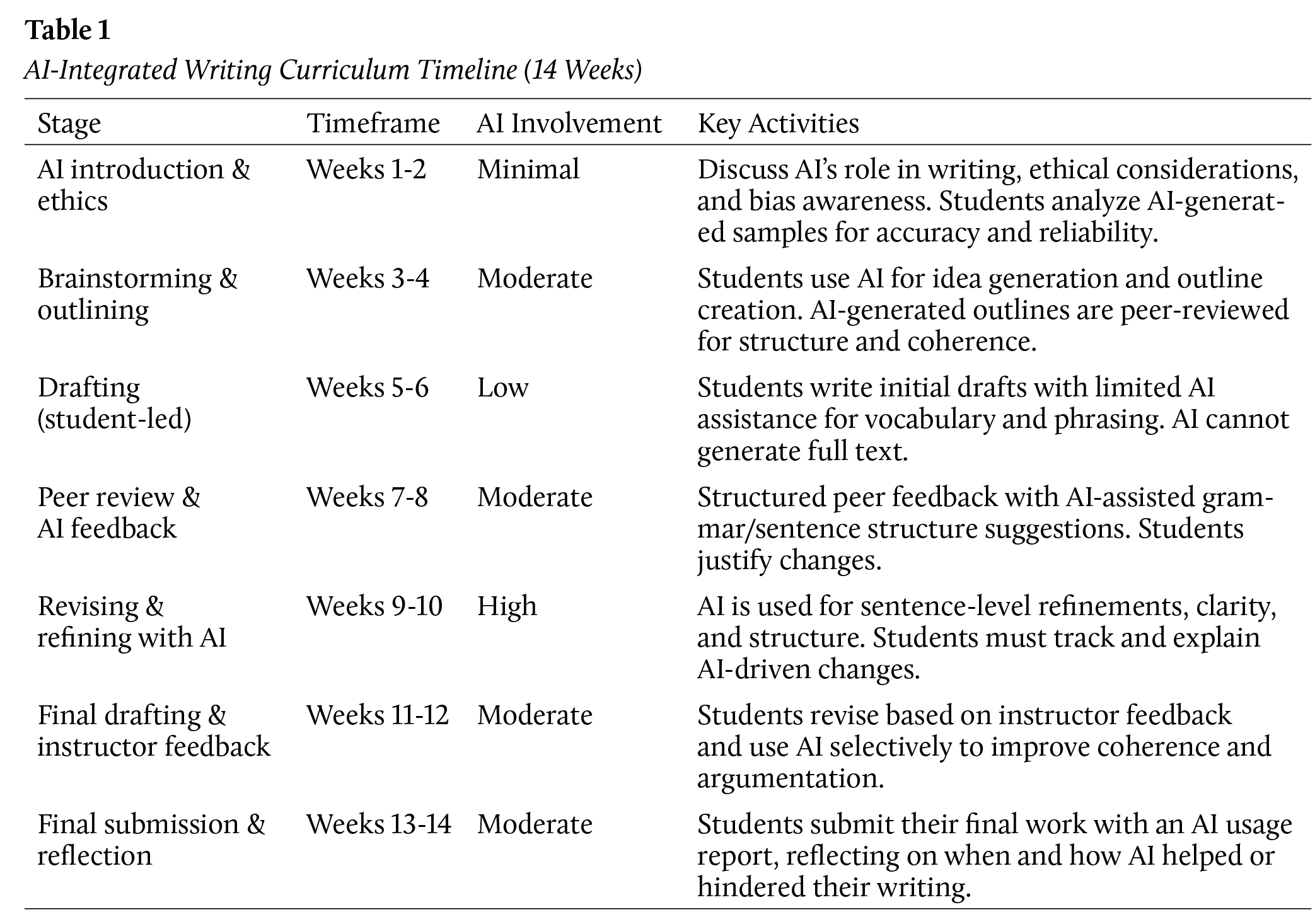
The first stage of the course focuses on brainstorming and outlining where AI assists with generating ideas and organizing main points. However, students must refine and justify their selections (Han et al., 2023). Then, it moves onto drafting: students write independently, using AI selectively for sentence structuring or vocabulary enhancement (Smutny & Schreiberova, 2020). After this students will focus on peer review and revision, where they will have structured feedback sessions to help students critically assess both human and AI-generated suggestions while refining their work (Han et al., 2023). In larger classes, organizing small-group discussions or rotating review sessions ensures that every student receives meaningful feedback without overwhelming the instructor (Smutny & Schreiberova, 2020). Finally, students will submit their final draft, along with a reflection on how they used AI throughout the process (Floridi & Chiriatti, 2020).
Checks are included in this type of curriculum to prevent AI misuse. Students will be required to produce AI interaction logs that document the AI-generated suggestions, indicating which recommendations were adopted, modified, or rejected (Han et al., 2023). Additionally, through process reports (i.e., brief reflections on how they used AI during drafting and revision), students can demonstrate their active role in shaping their work (Zhang et al., 2024). Oral interviews (i.e., one-on-one discussions) can help verify that students are internalizing writing concepts and not merely relying on AI outputs (Vanderpyl, 2012). Other checks can include in-class presentations, where students can present segments of their work and explain how AI influenced their revisions to reinforce accountability and provide instructors with opportunities for feedback. Table 1 is an example of an AI-integrated writing curriculum.
Addressing AI Challenges and Classroom Limitations
Integrating AI into writing instruction can be challenging for many reasons. For instance, AI-generated content may inherit biases from its training data and oversimplify complex ideas. This means that students must learn to critically assess and refine AI output, rather than accepting its output at face value (Floridi & Chiriatti, 2020).
Additionally, though AI can suggest alternative phrasing and generate sample texts, its responses sometimes lack a deeper understanding of certain topics. This requires human oversight to ensure that AI serves only as a starting point for student revisions (Han et al., 2023). As the quality of AI output is highly dependent on the input it receives (e.g., varying quality of text used to train the AI), students need to understand that AI can produce language of inconsistent quality and coherence. Therefore, developing effective prompt engineering skills is necessary for students to receive more relevant and nuanced assistance from AI (Zhang et al., 2024).
Practical classroom constraints are also a concern. Large class sizes can limit the possibility for personalized feedback, making group-based review sessions and structured peer feedback important. Additionally, student proficiency levels can be very different, requiring different levels of scaffolding to develop their independent writing skills (Smutny & Schreiberova, 2020). Effective time management is another challenge, as educators must integrate AI tools without compromising other critical aspects of the curriculum. All of these factors must be considered for this approach to be effective.
Future Considerations
Advancements in generative AI are rapidly reshaping educational practices. This offers the potential for more personalized writing instruction, adaptive learning environments, and strategies tailored to individual student needs (Han et al., 2023). However, as AI tools become more advanced and commonplace, there are concerns about its overreliance on technology, reinforcement of biases, and a diminishing of students’ critical thinking skills (Floridi & Chiriatti, 2020).
Current research on AI-assisted writing instruction demonstrates the need for new frameworks that evaluate the quality of students’ final texts, along with the development of their writing skills and critical reasoning over time (Zhang et al., 2024). Thus, future studies should explore how different models of AI integration impact long-term learning outcomes and determine whether structured AI usage supports learning.
Finally, ongoing professional development is essential for educators to stay aware of technological advancements. Instructors must update traditional pedagogical approaches to include training in AI literacy and prompt engineering. This will help ensure that students benefit from AI as a tool for learning, while continuing to build their fundamental skills.
Conclusion
Integrating AI into EFL writing instruction offers opportunities for enhancing the writing process, though it also poses significant challenges. AI tools can support brainstorming, drafting, and revision, but they must be integrated into a structured framework to ensure that students continue to develop writing skills independently (Han et al., 2023; Vanderpyl, 2012). When used responsibly, AI can provide valuable scaffolding without replacing critical thinking and creativity (Floridi & Chiriatti, 2020).
However, educators must remain vigilant about the limitations of AI, such as its potential to reinforce biases or produce inaccurate content. Ongoing research, including recent systematic reviews (Zhang et al., 2024), highlights the need for assessments that measure the quality of final texts and the development of writing processes. Additionally, practical classroom strategies—such as peer review, AI interaction logs, and tiered tasks—can help mitigate challenges such as large class sizes and varied student proficiency (Smutny & Schreiberova, 2020). Ultimately, balancing AI’s benefits with traditional pedagogical approaches is essential for developing effective, independent writers in an increasingly digital learning environment.
References
Floridi, L., & Chiriatti, M. (2020). GPT-3: Its nature, scope, limits, and consequences. Minds and Machines, 30(4), 681–694. https://doi.org/10.1007/s11023-020-09548-1
Han, J., Yoo, H., Kim, Y., Myung, J., Kim, M., Lim, H., Kim, J., Lee, T. Y., Hong, H., Ahn, S.-Y., & Oh, A. (2023). Recipe: How to integrate ChatGPT into EFL writing education. In D. Spikol (Ed.), L@S ‘23: Proceedings of the Tenth ACM Conference on Learning @ Scale (pp. 416–420). Association for Computer Machinery. https://doi.org/10.1145/3573051.3596200
Smutny, P., & Schreiberova, P. (2020). Chatbots for learning: A review of educational chatbots for the Facebook Messenger. Computers & Education, 151, 1–11. https://doi.org/10.1016/j.compedu.2020.103862
Vanderpyl, G. D. (2012). The process approach as writing instruction in EFL (English as a Foreign Language) classrooms [Master’s thesis, SIT Graduate Institute]. MA TESOL Collection. https://digitalcollections.sit.edu/ipp_collection/545
Zhang, X., Zhang, P., Shen, Y., Liu, M., Wang, Q., Gašević, D., & Fan, Y. (2024). A systematic literature review of empirical research on applying generative artificial intelligence in education. Frontiers of Digital Education, 1(3), 223–245. https://doi.org/10.1007/s44366-024-0028-5