This article introduces word recognition exercises as practical applications of the bottom-up reading model in teaching EFL reading. While various studies have emphasised the importance of word recognition skills in first language situations as a means of improving comprehension and encouraging learners to read, these skills have been neglected in the foreign language situation. This article argues that these exercises are particularly appropriate for foreign language use since they serve to stimulate beginner level foreign language learners to go beyond the first barrier of foreign language reading.
This paper describes how word recognition exercises were successfully applied in reading classes at a junior high school in Japan. To conduct the study, word recognition exercises were devised and implemented and student feedback was sought on the design of the exercise. Results obtained from the feedback along with data from the comparison of word test scores of students taught using a traditional approach and those taught using word recognition exercises are presented and discussed in the conclusion.
According to Gough (1972), comprehension takes place in a linear order of processing from individual letters to words, phrases to sentences, and finally, discourse to comprehending the message conveyed by the writer through the text. Here, reading is assumed to be primarily a decoding process of reconstructing the printed letters and words and building up meaning of a text from the smallest units of a sentence. This type of information processing is often called text-based or data-driven processing because processing is inspired by linguistic input from the text or the incoming data from the text (Silberstein, 1993).
One of the aspects of reading that the bottom-up model attempts to account for is the development of automaticity in word recognition (see Eskey & Grabe, 1988; La Berge & Samuels, 1974). Reading research in L1 has indicated the importance of accurate and rapid word recognition to the development of fluency in reading (Grabe, 1988; Stanovich, 1980). Paran (1996), for example, states, "automatic word recognition is indeed a major attribute of the L1 reader's reading behaviour" (p. 30). This has been observed especially with good readers who can use more word recognition skills and guess least about the meaning of the text because they do not have to: they already know the vocabulary. Conversely, poor readers are found to engage in a larger use of context to access meaning than good readers because they are considerably slow to identify words. (Paran, 1996; Williams, 1993). Research done by Rayner and Pollatsek (1989) is one of the oldest attempts to demonstrate that word recognition plays a crucial role in reading comprehension and as a result is seen as a landmark of the bottom-up reading model. There, they explore that readers fixate on approximately every 1.1 words of a text and thus conclude that reduced automaticity in word recognition leads to comprehension deficiency.
This is particularly relevant to EFL learners, especially students in Japanese junior high schools, whose reading experience in the target language is often limited to the intensive reading approach. Textbook in one hand and dictionary in the other, students struggling to draw meanings from the text become tired of having endlessly to look up every single word they encounter in the text. Consequently, many of the students appeared to have already built negative views on reading in the target language.
One obvious reason for any lack of progress suggested itself: students were simply not exposed to sufficient and effective decoding skill development exercises. In Japan it very much needs reiterating that reading classes by themselves are insufficient for the development of an adequate FL reading ability. Since much of the disadvantage of L2/FL readers seems to be connected to reduced automaticity of the reading process, it would therefore seem essential that providing help with the skills needed to recognize words effectively in foreign language be emphasised in the foreign language classroom (Segalowitz, Poulsen, & Komada, 1991).
Moreover, the question of how to apply the theory in practice is still unanswered. In recent publication on EFL reading in Japan, Ono (2000), for example, stresses the need of incorporating exercises of bottom-up processing skills, especially for poor readers, but does not suggest the practical application of bottom-up processing for the EFL teaching context. With this state of affairs in mind the present study attempts to introduce a word recognition exercise as a practical application of the theory.
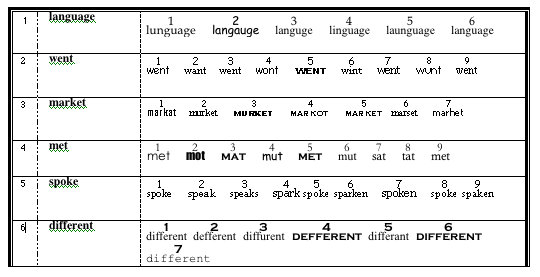
The word recognition skill developing exercise was invented in order to put into practice the bottom-up reading model. The exercise below, which has been adapted from Paran (1996), explains how to present word recognition exercises (see Figure 1). As can be seen, students are asked to identify misspelt words and words that appear in different typefaces (i.e. roman, italic, and bold). They are also required to finish the exercise within a limited time. The repetitive and rapid encounters of vocabulary in achieving the exercise are expected to provide the learners with "massive amounts of repetitive experience" (Segalowitz, et al., 1991, p. 23) that is assumed to be the best and only way to encourage the learners to develop decoding skill. Since Paran's original was intended for adult second language learners, and the students in the context are young Japanese learners, some small adjustments have been made for the differences in age and language ability.
The students were collected from two classes at a Japanese junior high school. At the time of the study, they were learning English in preparation for high school entrance examinations. Their English level was beginner and their average age was 14. Students attend three 50-minute classes a week. The course was compulsory and all students were enrolled in one first-year English language course in which development of reading skill was an integral part. The main requirement of this course was to read one textbook: New Crown 1: English Series (Morizumi, 2002). This textbook has 107 pages; each of its nine chapters contains three sections (two to four pages total) and approximately 18-22 newly introduced terms. Class work consisted of going through one or two sections during the class periods.
Below are some excerpts from students' self-evaluation forms. This daily self-evaluation form was kept by 77 students as a part of their English class. In these self-evaluation forms, the students wrote about actual learning events and described how they tried to understand, the problem they experienced and how they had overcome them. The following excerpts give concrete examples of how students responded to every aspect of the development of the word recognition exercises and how the examiner followed up with exercises (students were allowed to write their comments in Japanese thus the quotations that appear in this section are my translations).
(Student A) I have never noticed the importance of word recognition in reading without your exercise. I thought the exercise was very easy in the beginning though you said it would be tough. I realised that I always did not pay enough attention to the accurate spelling of words. I decided to study harder on vocabulary. I also liked the exercise very much because I could compete with my friends. I think I am better at recognising words correctly than other students.
(Student B) I could not finish the exercise within the limited time. I found that I spent too much time guessing the meaning. I decided to memorise the meaning of new vocabulary more accurately so that I do not have to waste time on guessing the meaning on the next exercise.
(Student C) When I was looking for the correct answer out of misspelt terms, I found that I had incidentally memorised the words. To tell the truth, I was not good at memorising new vocabulary because I often found that words do not remain in my memory. I like this exercise.
One of the biggest criticisms of this kind of exercise is that it is not appropriate for advanced students. I told such students that the exercise was not as easy as it looked. At the same time, the students were encouraged to do the exercise rapidly, but also warned not to make a single mistake. These instructions turned out to be quite effective not only with those students who had negative views on "simple" exercises as such, but also those who reacted positively to the exercises but made a lot of mistakes. It appears that students found pleasure in competing with peers in not only time but also accuracy. Many of the advanced students, in fact, showed their surprise that they could not achieve as much as they expected in the beginning.
An appealing fact gained as a result of the introduction of the exercise is that students found the exercise a useful way to memorise newly introduced words. Several wrote in their self-evaluation forms that they were amazed at their improvement in memorizing the English terms. It was a great surprise for the examiner that many of the once reluctant students showed favourable responses to the exercises and requested the continuous use of them. The results appear to indicate that word recognition exercises are an efficient way of not only developing automaticity of word recognition, but also improving attitudes in foreign language reading in the language classroom. Moreover, the training of students in the skill appears to affect their success in learning English in general.
The students performed well on the post-test. According to the results of an end-of-month experiment, which was designed to shed light on whether word recognition exercises improve students' memorization, it appears that the word recognition exercise would be an effective tool to develop students' vocabulary. The experiment here defines the two classes as: 1) an experimental group which participated in the four word recognition exercises for half the semester--roughly a month's participation; and 2) a control group of two classes that had no exposure to the word recognition exercise and approached their vocabularies from a traditional vocabulary instruction standpoint: that is, practicing the words in their notebooks several times. At the end of the experimental period, one word test that contained approximately 100 words was administered as a post-test. Results of the test are shown in Table 1. There was a significant amount of gain in the experimental group: nearly 80% of words being recognized correctly by the group while less than 70% of the words being achieved by the control group. The result appears to show that the word recognition exercise was superior to a traditional approach, but we must interpret the results in light of population under study and the experimental conditions.
| The experimental group (N = 77) | The control group (N = 76) | |
| Scores | 78% | 66% |
Although the study is limited in both scale and duration, this qualitative research highlights the impact of word recognition exercises on the development of foreign language reading and sheds light on students' views on how we should teach vocabulary in the foreign language classroom. Although it was impossible to know how exactly the students had acquired the words in the long term, the above excerpts appear to indicate that learners with only a basic level of proficiency in English have gained positive views on reading as well as developing better word recognition skills.
The implication for teaching reading fluency is that whenever possible teachers should set aside a time for providing the learners with word recognition exercises, especially to those poor readers who are often found to have deficiency in fluent reading and hence a poor understanding of the text. Word recognition exercises are the simplest and most direct tools for encouraging students to enter and explore the reading experience. It is hoped that word recognition exercises will help learners to improve their level of reading fluency and consequently encourage them to read more, thereby breaking the vicious circle in which weak readers tend to be trapped: they do not enjoy reading because they do not understand, and because they do not understand, they do not read.
Since the word recognition exercise I developed only ran for one month, and it was limited to two small groups at one junior high school in Japan, my results must be treated with some caution. Nevertheless, I feel the study has produced some interesting findings and they suggest that word recognition skill development can be an effective and pleasurable way for students to develop a positive attitude to reading in English. Results indicate, for example, that as a result of undertaking the exercise, several students who have had negative attitudes towards reading became more positive learners of English. In addition, many students indicated the wish to continue the programme, and many commented that the materials used in the classrooms were useful and enjoyable. I am now in the process of analysing the results of a repetition of the experiment in the 2002 academic year with an improved design, and hope to report on this in the near future.
The author would like to express her gratitude to Sarah Rich at the University of Exeter, for support and guidance on this paper.
Eskey, D. E., & Grabe, W. (1988). Interactive models for second language learning: Perspectives on instruction. In P. L. Carrell, J. Devine, & D. Eskey (Eds.), Interactive approaches to second language reading. Cambridge: Cambridge University Press.
Gough, P. B. (1972). One second of reading. In J. Kavanagh & G. Mattingly (Eds.), Language by ear and by eye. Cambridge, MA: MIT Press.
Grabe, W. (1988). Reassessing the term interactive. In P. L. Carrell, J. Devine, & D. Eskey (Eds.), Interactive approaches to second language reading. Cambridge: Cambridge University Press.
La Berge, D., & Samuels, J. (1974). Towards a theory of authentic information processing in reading. Cognitive Psychology, 6, 293-323.
Morizumi, E. (2002). New Crown 1: English series. Tokyo: Sanseido.
Ono, N. (2000). Dokkai purosesu [Reading process]. In T. Takanashi & Y. Ushiro (Eds.), Eigo riidingu jiten [English reading encyclopedia]. Tokyo: Kenkyusha.
Paran, A. (1996). Reading in EFL: Facts and fictions. ELT Journal, 49(1), 25-34.
Rayner, K., & Pollatsek, A. (1989). The psychology of reading. Englewood Cliffs, NJ: Erlbaum.
Segalowitz, N., Poulsen, C., & Komada, M. (1991). Lower level components of reading skill in higher level bilinguals: Implications for reading instruction. In J. H. Hulstijn & J. F. Matthew (Eds.), Reading in two languages. AILA Review 8, 15-30.
Silberstein, S. (1993). Techniques and resources in teaching reading. Oxford: Oxford University Press.
Stanovich, K. (1980). Towards an interactive compensatory model of individual differences in the development of reading fluency. Reading Research Quarterly, 16(1), 32-71.
Williams, E. (1993). First and second language reading proficiency of year 3,4, and 6 children in Malawi and Zambia. Reading in a Foreign Language, 10(1), 915-929.